Similarity and Congruence of Shapes
Congruence and similarity are two fundamental concepts in geometry. Congruent shapes are exactly the same size and shape. Similar shapes have the same shape but may be different sizes. Understanding these concepts allows you to prove geometric relationships and solve problems involving unknown lengths, areas, and volumes.
Before You Begin: Make sure you have reviewed our Transformations page. Congruence is closely related to isometric transformations (translations, rotations, and reflections), while similarity relates to enlargements and stretches.
Congruence
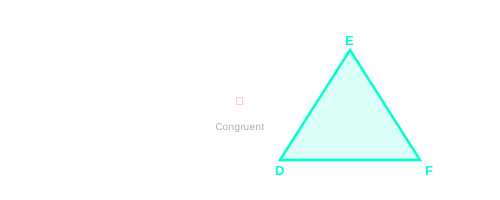
Two shapes are congruent if they are exactly the same shape and the same size. One shape can be mapped onto the other through a combination of translations, rotations, and reflections (isometric transformations).
Key Properties of Congruent Figures:
• All corresponding sides are equal in length.
• All corresponding angles are equal in measure.
• One shape can be transformed to exactly cover the other.
• Same area and same perimeter.
• Symbol: ≅ (e.g., ΔABC ≅ ΔDEF).
Congruence Postulates
To prove two triangles are congruent, you only need to show that three specific parts (sides and/or angles) match. The following postulates are the standard tests for triangle congruence:
SSS (Side-Side-Side)
If three sides of one triangle are equal to three sides of another triangle, the triangles are congruent.

SAS (Side-Angle-Side)
If two sides and the included angle of one triangle are equal to two sides and the included angle of another, the triangles are congruent.

AAS (Angle-Angle-Side)
If two angles and a non-included side of one triangle are equal to two angles and the corresponding non-included side of another, the triangles are congruent.

RHS (Right-angle-Hypotenuse-Side)
If the hypotenuse and one side of a right-angled triangle are equal to the hypotenuse and one side of another right-angled triangle, the triangles are congruent.

Note: AAA (Angle-Angle-Angle) is not a congruence postulate. It proves similarity, not congruence.
Proving Congruence
To prove that two triangles are congruent, follow these steps:
- Identify the corresponding sides and angles in both triangles.
- State which sides are equal (mark them on the diagram).
- State which angles are equal (mark them on the diagram).
- State the congruence postulate that applies (SSS, SAS, AAS, or RHS).
- Write the congruence statement (e.g., ΔABC ≅ ΔDEF).
Example 1: Proving Congruence (SAS)
In the diagram below, AB = DE, AC = DF, and ∠BAC = ∠EDF. Prove that ΔABC ≅ ΔDEF.

Proof using a table:
| Statement | Reason |
|---|---|
| AB = DE | Given |
| AC = DF | Given |
| ∠BAC = ∠EDF | Given |
| ∴ ΔABC ≅ ΔDEF | SAS (Side-Angle-Side) |
Important: When writing a proof, always include a conclusion statement. The final line should state that the triangles are congruent and give the postulate used.
Similarity
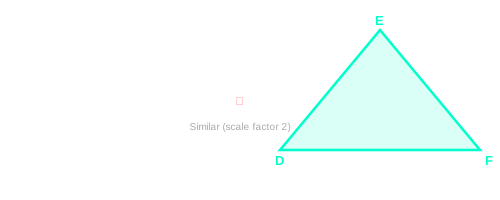
Two shapes are similar if they have the same shape but may be different sizes. One shape can be mapped onto the other through an enlargement (or stretch). Corresponding angles are equal, and corresponding sides are in the same ratio.
Key Properties of Similar Figures:
• All corresponding angles are equal.
• All corresponding sides are in the same ratio (common scale factor).
• One shape is an enlargement or reduction of the other.
• Area ratio = (scale factor)²
• Volume ratio = (scale factor)³ (for 3D shapes)
• Symbol: ∼ (e.g., ΔABC ∼ ΔDEF).
Similarity Postulates
To prove two triangles are similar, you only need to show that two conditions are met. The following postulates are the standard tests for triangle similarity:
AAA (Angle-Angle-Angle)
If three angles of one triangle are equal to three angles of another triangle, the triangles are similar.
Note: If two angles are equal, the third is automatically equal (angle sum of a triangle).

SSS (Side-Side-Side)
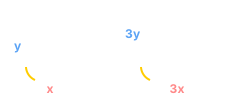
If three sides of one triangle are in the same ratio as three sides of another triangle, the triangles are similar.
SAS (Side-Angle-Side)
If two sides are in the same ratio and the included angle is equal, the triangles are similar.
RHS (Right-angle-Hypotenuse-Side)
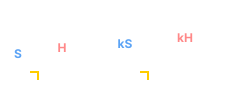
If the hypotenuse and one side of a right-angled triangle are in the same ratio as the hypotenuse and one side of another right-angled triangle, the triangles are similar.
Proving Similarity
To prove that two triangles are similar, follow these steps:
- Identify the corresponding sides and angles in both triangles.
- State which angles are equal (mark them on the diagram).
- Show that the ratios of corresponding sides are equal, or state which angles are equal.
- State the similarity postulate that applies (AAA, SSS, or SAS).
- Write the similarity statement (e.g., ΔABC ∼ ΔDEF).
Example 2: Proving Similarity (AAA)
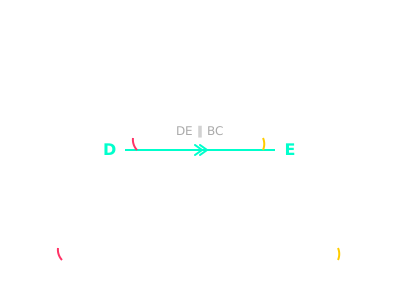
In the diagram below, DE is parallel to BC. Prove that ΔADE ∼ ΔABC.
Proof using a table:
| Statement | Reason |
|---|---|
| ∠ADE = ∠ABC | Corresponding angles (DE ∥ BC) |
| ∠AED = ∠ACB | Corresponding angles (DE ∥ BC) |
| ∠DAE = ∠BAC | Common angle |
| ∴ ΔADE ∼ ΔABC | AAA (Angle-Angle-Angle) |
Example 3: Finding the Linear Scale Factor
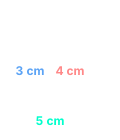
Triangle ABC

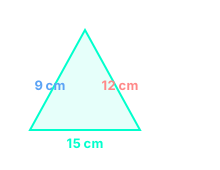
Triangle DEF
Triangle ABC has sides of length 3 cm, 4 cm, and 5 cm. Triangle DEF is similar to ABC and has a longest side of 15 cm. Find the scale factor.
Step 1: Identify corresponding sides.
Longest side of ABC = 5 cm
Longest side of DEF = 15 cm
Step 2: Calculate the scale factor.
k = 15 ÷ 5 = 3
Answer: The scale factor is 3 (enlargement).
Example 4: Finding Unknown Lengths

Smaller Rectangle

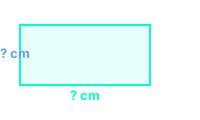
Larger Rectangle
Two similar rectangles have a scale factor of 2.5. If the smaller rectangle has a width of 8 cm, what is the width of the larger rectangle?
Step 1: Use the scale factor formula.
Larger width = k × smaller width = 2.5 × 8 cm = 20 cm
Answer: The larger rectangle has a width of 20 cm.
Area and Volume of Similar Figures
When two figures are similar with linear scale factor k, the following relationships apply:
Area Ratio
Area ratio = k²
The area of the image is k² times the area of the object.
Volume Ratio (3D)
Volume ratio = k³
The volume of the image is k³ times the volume of the object.
Example 5: Area of Similar Shapes
Two similar triangles have a linear scale factor of 2. If the smaller triangle has an area of 10 cm², find the area of the larger triangle.
Step 1: Recall the area ratio formula.
Area ratio = k² = 2² = 4
Step 2: Multiply the smaller area by the area ratio.
Larger area = 4 × 10 cm² = 40 cm²
Answer: The larger triangle has an area of 40 cm².
Example 6: Volume of Similar Shapes
Two similar cylinders have a linear scale factor of 3. If the smaller cylinder has a volume of 20 cm³, find the volume of the larger cylinder.
Step 1: Recall the volume ratio formula.
Volume ratio = k³ = 3³ = 27
Step 2: Multiply the smaller volume by the volume ratio.
Larger volume = 27 × 20 cm³ = 540 cm³
Answer: The larger cylinder has a volume of 540 cm³.
Important:
• Area scales by k² (square of the linear scale factor).
• Volume scales by k³ (cube of the linear scale factor).
• Always identify the linear scale factor first before calculating area or volume ratios.
Summary Table: Congruence vs Similarity
| Property | Congruence (≅) | Similarity (∼) |
|---|---|---|
| Corresponding angles | Equal | Equal |
| Corresponding sides | Equal in length | Same ratio (scale factor k) |
| Shape | Exactly the same | Same shape, possibly different size |
| Area relationship | Equal areas | Area ratio = k² |
| Volume relationship (3D) | Equal volumes | Volume ratio = k³ |
| Postulates for triangles | SSS, SAS, AAS, RHS | AAA, SSS, SAS |
| Transformation | Translation, rotation, reflection | Enlargement or reduction |
Key Takeaways:
• Congruent shapes: same shape and size. Corresponding sides and angles are equal.
• Similar shapes: same shape, different size. Corresponding angles are equal; sides are in the same ratio.
• Use SSS, SAS, AAS, or RHS to prove congruence.
• Use AAA, SSS, or SAS to prove similarity.
• Linear scale factor k: image length ÷ object length.
• Area ratio = k², Volume ratio = k³.
• Always end a proof with a conclusion statement.
NB: Congruence and similarity are powerful tools in geometry. They allow you to find unknown lengths, areas, and volumes without measuring directly. Practice identifying corresponding sides and angles, and always justify your steps when writing proofs.